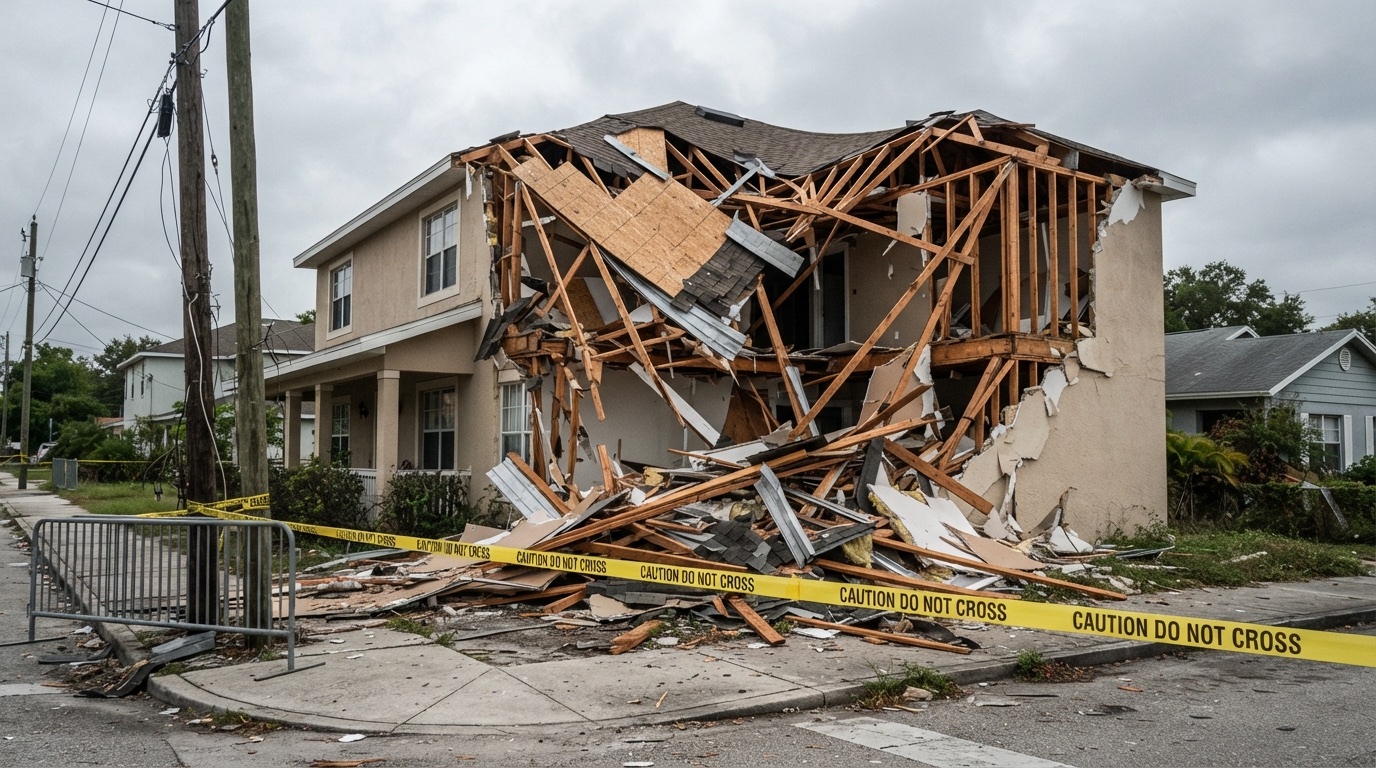
Collapse is one of the most technical coverage questions in a property policy, because the word means something specific. Most policies cover "abrupt" collapse, a sudden falling in or caving of a structure, from defined causes, and exclude a building that is merely cracking, settling, bulging, or in the process of failing. The line between the two is where these claims are fought.
Because collapse often follows a hidden cause, decay, a failed structural element, water intrusion, the claim requires engineering to establish both that a collapse (as the policy defines it) occurred and what caused it. This is not a loss to document with photographs alone.
What decides a collapse claim in Florida.
The policy definition of collapse
Coverage usually requires an abrupt collapse from specified causes, and excludes gradual settling, cracking, or bulging even when a structure is clearly failing. Establishing that the loss meets the policy's definition is the threshold question.
Hidden decay and covered causes
Many policies cover collapse caused by hidden decay or a covered peril the owner could not have known about. Identifying and documenting that qualifying cause is what brings the loss inside coverage.
Engineering carries the claim
A structural engineer's report establishes the mechanism, the cause, and the extent of the collapse. Without it, a carrier will characterize the loss as excluded settlement or deterioration.
The Florida rules that decide a collapse claim
Collapse is defined by the policy, not by common sense, and Florida added a structural-safety layer on top of it after Surfside. These sections were read from the Florida Legislature the day this page was last updated.
What counts as collapse is a policy definition
Most Florida commercial and association policies define collapse narrowly, often requiring an abrupt falling down or caving in, and expressly exclude a building that is still standing even where it is in danger of falling. That definition, not the engineering report alone, decides the claim, so the policy language governs the strategy.
A milestone or structural integrity reserve study finding is not automatically a maintenance item
Milestone inspection and structural integrity reserve study findings routinely surface damage that has a covered cause behind it. The report is engineering, not a coverage determination, and treating every finding as deferred maintenance is how associations write off recoverable losses.
One year to give notice, eighteen months to supplement, for any peril
Section 627.70132(2) bars a claim or reopened claim unless notice reached the insurer within one year of the date of loss, and bars a supplemental claim after 18 months. It reaches loss or damage caused by any peril, not only weather.
The carrier is on a clock, and most policyholders never see it
Section 627.70131 puts hard deadlines on a residential property insurer: 7 calendar days to acknowledge a claim communication, 7 days after proof-of-loss statements to begin the investigation, 30 days to physically inspect, 7 days to send you a copy of any detailed estimate its adjuster generated, and under subsection (7)(a), 60 days from notice of the claim to pay or deny it with a written explanation. Section 627.4025(1) makes residential coverage include commercial lines residential policies, which covers condominium association, cooperative, and apartment building policies and policies on homeowners association common elements. A pure commercial policy on an office or retail building sits outside this section.
Statute text read from the Florida Legislature on 2026-08-24. General information only, not legal advice or a coverage determination. Coverage depends on your specific policy, the facts of your loss, and current Florida law.
What the carrier will try on a collapse claim.
- —Characterizing the loss as excluded settling, cracking, or gradual deterioration.
- —Arguing the structure did not "abruptly" collapse under the policy definition.
- —Denying the qualifying cause without an engineering evaluation.
- —Scoping only the failed element and ignoring the broader structural damage.
We Build Your Claim The Way Ford Built The Assembly Line.
Henry Ford didn’t try to be the expert at everything. He surrounded himself with specialists, each mastering one part of the work, and assembled the result into something no individual could build alone. We document claims the same way. For a serious loss, one adjuster’s opinion is not enough, so we bring in the right specialists, pull a full report from each, and assemble them into a claim the carrier cannot dismiss.
Building Consultants
Read the structure and the code the way an insurer’s engineer does, so nothing covered gets left out of scope.
General Contractors
Real-world repair pricing and sequencing that holds up when the carrier questions the cost to rebuild.
Structural Engineers
Independent reports on causation and structural damage that carry weight the carrier can’t wave off.
Professional Estimators
Line-item Xactimate estimates built to the same software and standards the carrier’s own adjuster uses.
Contents Specialists
Full inventory and valuation of damaged personal property and business contents, item by item.
Water & Mold Testing
Moisture mapping, thermal imaging, and lab testing that prove the source, the spread, and the cause of loss.
We don’t send an adjuster. We send a team.
These specialists are independent third-party professionals brought in for documentation and evidence purposes. CCG does not perform repair work and holds no financial interest in any repair or remediation contract.
Collapse claims: what Florida property owners ask.
What counts as "collapse" under my insurance policy?
Most policies define it narrowly, an abrupt falling in or caving of a building or part of it, from specified causes. A structure that is cracking, settling, or bulging usually does not qualify on its own. The policy definition, and an engineer's read of it, controls the claim.
My building is failing but has not fully fallen. Is that covered?
It depends on the policy language and the cause. Some policies cover collapse from hidden decay or a covered peril; others require an abrupt event. This is a technical determination that turns on engineering and the specific wording, which is exactly where representation matters.
The carrier called it "settlement" and denied it. Now what?
Settlement is an exclusion carriers reach for reflexively. If a qualifying cause, such as hidden decay or a covered peril, produced the collapse, the denial can be challenged. A structural engineer's report is usually decisive.
Why do collapse claims need an engineer?
Because coverage turns on the mechanism and cause of the failure, not just its appearance. An engineering report establishes what happened and why, and connects it to the policy's definition and covered causes.
General information only, not legal advice or a coverage determination. Coverage depends on your specific policy, the facts of your loss, and current Florida law.
Denied, underpaid, or already closed? Florida law may still give you time to reopen a collapse claim.
Have a collapse loss? Start with a free review.
James reviews every submission personally and responds within 24 hours. No obligation, and no fee unless we recover for you.
← All claim typesReport Your Claim
We respond within 24 hours.