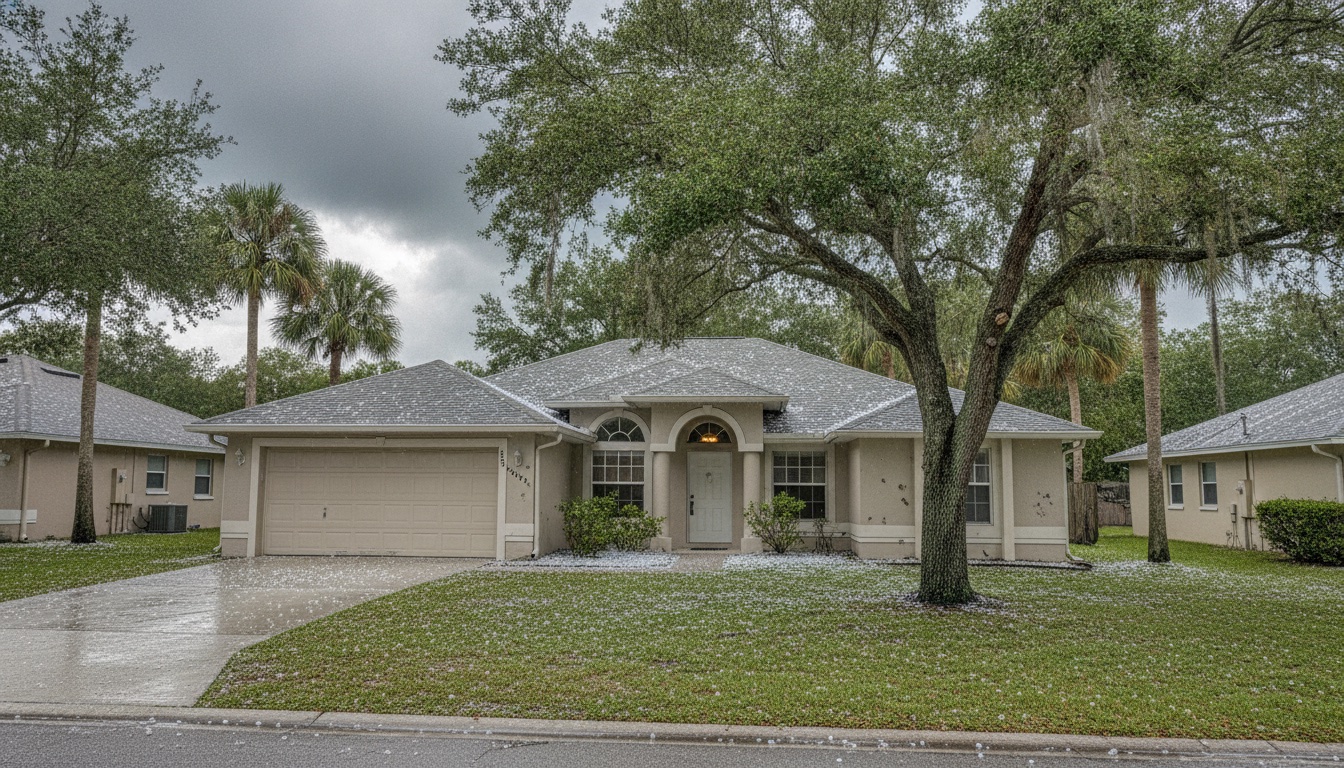
Hail is the loss carriers minimize most confidently, because the damage is easy to underplay from the ground. Impact bruising fractures the shingle mat, knocks the protective granules loose, and dents metal, vents, and soft metals long before the roof visibly fails. Left unaddressed, those fractures shorten the roof's life and open the door to leaks months later.
A hail claim is won slope by slope, on the roof, with the damage marked, measured, and photographed. It is not won from a driveway or a satellite image, which is exactly where carriers prefer to evaluate it.
What decides a hail claim in Florida.
Functional damage the carrier calls cosmetic
Insurers routinely label hail bruising and granule loss "cosmetic" to avoid replacement. But granule loss exposes the asphalt to UV and accelerates failure, and fractured mats do not seal. We document the functional damage, not just the appearance.
Test squares and slope-by-slope counts
Legitimate hail evaluation uses marked test squares to count impacts per slope against industry thresholds. We document every slope, plus the soft-metal collateral (vents, gutters, flashing, screens, AC fins) that corroborates a real hail event.
Matching turns a slope into a roof
When damaged shingles are discontinued or cannot be matched to the rest of the roof, Florida law can require replacement to a uniform appearance. Carriers prefer to pay for a few slopes; matching is often what makes the claim whole.
The Florida rules that decide a hail claim
Hail is the one Florida peril where the same damage can carry two completely different deductibles depending on when it fell. These are the operative sections, read from the Florida Legislature the day this page was last updated.
Hail during a hurricane is hurricane coverage, not ordinary wind
Section 627.4025(2)(b) defines windstorm, for hurricane-coverage purposes, as wind, wind gusts, hail, rain, tornadoes, or cyclones caused by or resulting from a hurricane. So hail that falls inside the hurricane window is hurricane damage, and the percentage hurricane deductible applies rather than the flat all-other-perils deductible. On a large association building that single classification can swing six figures.
The hurricane window is defined by warnings, not by the storm overhead
Under 627.4025(2)(c) the hurricane runs from the moment a hurricane warning is issued for any part of Florida and ends 72 hours after the last hurricane watch or warning for any part of Florida is terminated. A hailstorm 200 miles from the track can still fall inside that window. Checking the actual warning timeline is part of the claim, not a formality.
NOAA sets your date of loss, not the day you noticed the damage
For hail, wind, and other weather events, 627.70132(3) fixes the date of loss as the date the event is verified by the National Oceanic and Atmospheric Administration. That date is what the notice deadline runs from, and it is verifiable from public records rather than from a carrier's file note.
One year to give notice, eighteen months for a supplemental claim
Section 627.70132(2) bars a claim or reopened claim unless notice was given within one year of the date of loss, and bars a supplemental claim after 18 months. It applies to loss from any peril, so a hail claim is on the same clock as a hurricane claim.
Matching is statutory on a homeowner policy and a policy question on a master policy
Section 626.9744(2) requires an insurer to make reasonable repair or replacement in adjoining areas when replaced items do not match in quality, color, or size, and by its own terms that section governs homeowner insurance policies. On a commercial or association master policy, matching turns on the policy language instead, which is exactly why the roof scope on an association building has to be argued from the policy rather than assumed.
Statute text read from the Florida Legislature on 2026-08-24. General information only, not legal advice or a coverage determination. Coverage depends on your specific policy, the facts of your loss, and current Florida law.
What the carrier will try on a hail claim.
- —Evaluating the roof from the ground or by aerial imagery instead of on the slopes.
- —Labeling functional hail damage as "cosmetic" to deny replacement.
- —Paying for isolated slopes and ignoring matching of the full roof.
- —Blaming pre-existing wear, foot traffic, or manufacturing defects.
We Build Your Claim The Way Ford Built The Assembly Line.
Henry Ford didn’t try to be the expert at everything. He surrounded himself with specialists, each mastering one part of the work, and assembled the result into something no individual could build alone. We document claims the same way. For a serious loss, one adjuster’s opinion is not enough, so we bring in the right specialists, pull a full report from each, and assemble them into a claim the carrier cannot dismiss.
Building Consultants
Read the structure and the code the way an insurer’s engineer does, so nothing covered gets left out of scope.
General Contractors
Real-world repair pricing and sequencing that holds up when the carrier questions the cost to rebuild.
Structural Engineers
Independent reports on causation and structural damage that carry weight the carrier can’t wave off.
Professional Estimators
Line-item Xactimate estimates built to the same software and standards the carrier’s own adjuster uses.
Contents Specialists
Full inventory and valuation of damaged personal property and business contents, item by item.
Water & Mold Testing
Moisture mapping, thermal imaging, and lab testing that prove the source, the spread, and the cause of loss.
We don’t send an adjuster. We send a team.
These specialists are independent third-party professionals brought in for documentation and evidence purposes. CCG does not perform repair work and holds no financial interest in any repair or remediation contract.
Hail claims: what Florida property owners ask.
How do I know if my roof actually has hail damage?
The reliable signs are impact bruises that fracture the shingle mat, concentrated granule loss, and dents to soft metals like vents, gutters, and AC fins. Much of it is not visible from the ground, which is why an on-roof inspection matters.
The insurance company says my hail damage is only "cosmetic." Is that true?
Often not. Granule loss and mat fractures are functional damage that shortens the roof's life and leads to leaks, even when the roof still looks intact. We document the functional impact, not just the appearance, and pursue it.
Do I need a whole new roof or just the damaged slopes?
It depends on the extent of damage and whether the shingles can be matched. When damaged shingles are discontinued or cannot be matched to the undamaged slopes, Florida law can require replacement to a uniform appearance rather than a patch.
How long do I have to file a hail claim in Florida?
Notice deadlines generally run from the date of loss (commonly one year for a new claim and 18 months for a supplemental claim), but they vary by policy. Hail damage can take months to reveal itself as leaks, so document and report it as soon as you suspect it.
General information only, not legal advice or a coverage determination. Coverage depends on your specific policy, the facts of your loss, and current Florida law.
Denied, underpaid, or already closed? Florida law may still give you time to reopen a hail claim.
Have a hail loss? Start with a free review.
James reviews every submission personally and responds within 24 hours. No obligation, and no fee unless we recover for you.
← All claim typesReport Your Claim
We respond within 24 hours.