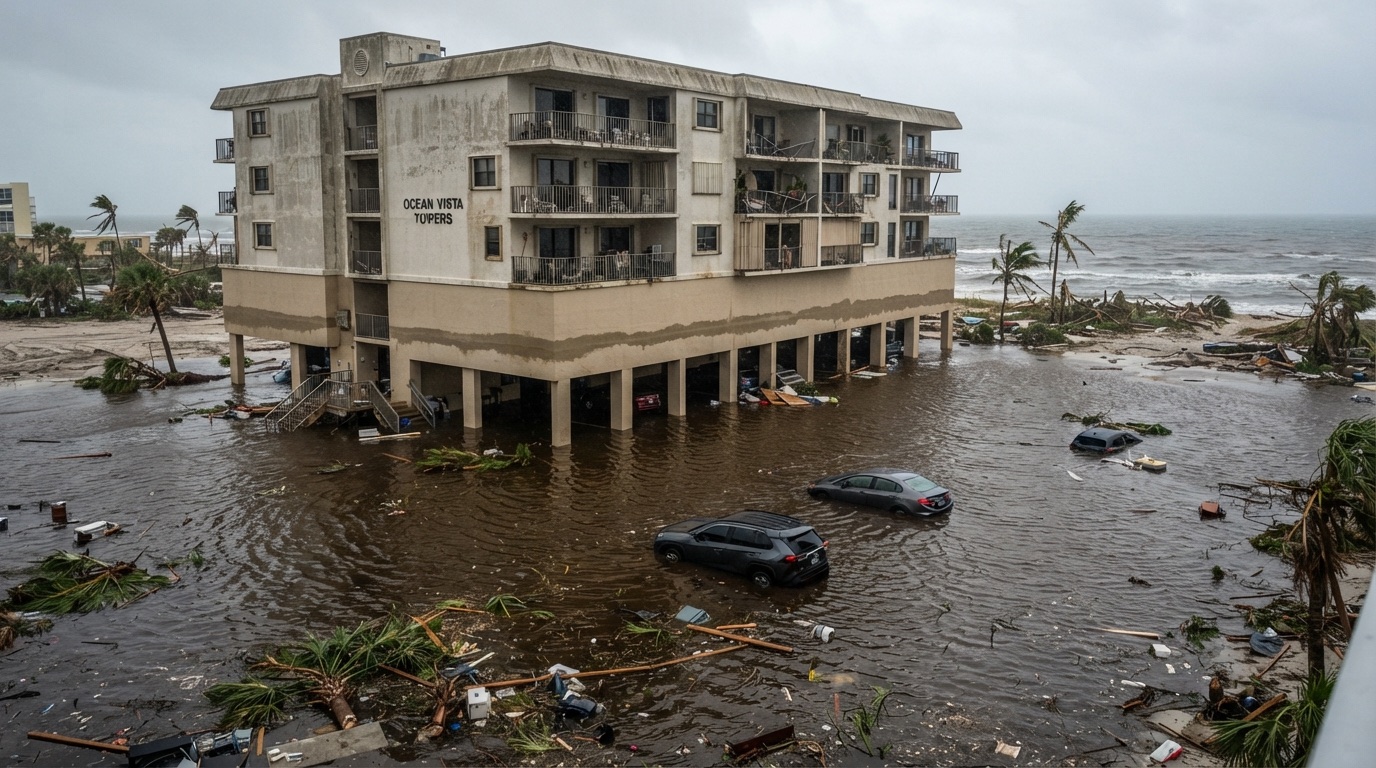
For a coastal Florida condominium or apartment community, floodwater and storm surge are the loss the standard property policy does not touch. Flood is excluded from commercial property coverage and requires separate flood insurance. After a hurricane, that sets up the fight that decides everything: how much of the damage was wind, paid by the master property policy, and how much was flood, paid, if at all, by a separate flood policy.
A commercial flood claim is really two claims fighting over a waterline: the property carrier pushing damage toward excluded flood, and the flood carrier minimizing what it owes. Ground-floor units, lobbies, parking structures, elevators, and building mechanicals are usually where surge does its worst, and where the causation battle is won or lost on documentation.
What decides a commercial flooding claim.
Flood is not covered by your property policy
Standard commercial property and association master policies exclude flood and storm surge. Coverage comes from a separate flood policy (NFIP or private flood), which many coastal associations carry alongside their property policy. Knowing which policy owes which damage is the starting point of the claim.
Wind versus flood is the whole battle
In a hurricane, the carrier that would owe wind damage argues it was flood, and the flood carrier argues the reverse. Storm surge is generally flood; wind-driven rain through a wind-created opening is generally wind. Establishing the cause, and the sequence, of the water is frequently the entire claim.
The surge damage is in the parts you rely on
Floodwater concentrates in ground-floor units, lobbies, parking, elevators, electrical, and mechanical systems, the parts of the building that are expensive to restore and easy for a carrier to under-scope. We document the waterline and the full extent of what the water reached.
What the carrier will try on a commercial flooding claim.
- —Pushing wind-covered damage toward the excluded flood policy (and vice versa).
- —Under-valuing flood damage to elevators, electrical, and building mechanicals.
- —Disputing the waterline and the sequence of wind versus flood.
- —Delaying between two carriers so the association carries the loss while they argue.
We Build Your Claim The Way Ford Built The Assembly Line.
Henry Ford didn’t try to be the expert at everything. He surrounded himself with specialists, each mastering one part of the work, and assembled the result into something no individual could build alone. We document claims the same way. For a serious loss, one adjuster’s opinion is not enough, so we bring in the right specialists, pull a full report from each, and assemble them into a claim the carrier cannot dismiss.
Building Consultants
Read the structure and the code the way an insurer’s engineer does, so nothing covered gets left out of scope.
General Contractors
Real-world repair pricing and sequencing that holds up when the carrier questions the cost to rebuild.
Structural Engineers
Independent reports on causation and structural damage that carry weight the carrier can’t wave off.
Professional Estimators
Line-item Xactimate estimates built to the same software and standards the carrier’s own adjuster uses.
Contents Specialists
Full inventory and valuation of damaged personal property and business contents, item by item.
Water & Mold Testing
Moisture mapping, thermal imaging, and lab testing that prove the source, the spread, and the cause of loss.
We don’t send an adjuster. We send a team.
These specialists are independent third-party professionals brought in for documentation and evidence purposes. CCG does not perform repair work and holds no financial interest in any repair or remediation contract.
Commercial flooding claims: what boards and operators ask.
Does our association property policy cover flood damage?
Generally no. Standard commercial property and association master policies exclude flood and storm surge; that damage is covered, if at all, by a separate flood policy (NFIP or private flood). Many coastal associations carry both, and part of our job is establishing which policy owes which damage.
Is storm surge considered wind or flood?
Storm surge is generally treated as flood, while wind and wind-driven rain through a wind-created opening are generally covered by the property policy. Because a hurricane brings both, the causation and sequence of the water usually decide how much each policy pays.
Why does wind versus flood matter so much?
Because they are different policies with different limits and deductibles, and each carrier has an incentive to blame the other. If the damage is documented as flood when it was wind, the association can be dramatically underpaid. We document the cause so the right policy pays the right amount.
We have flood insurance. Do we still need help?
Often yes. Flood claims are technical, and both the flood and property carriers will minimize what they owe and point at each other. Documenting the waterline, the cause, and the full extent, especially to mechanicals and common areas, is what protects the association’s recovery.
General information only, not legal advice or a coverage determination. Coverage depends on your association’s or building’s specific policy, the facts of your loss, and current Florida law.
Have a flooding loss at your property? Start with a free review.
James reviews every commercial submission personally and responds within 24 hours. No obligation, and no fee unless we recover for you.
← Commercial DivisionReport a Commercial Loss
We respond within 24 hours.