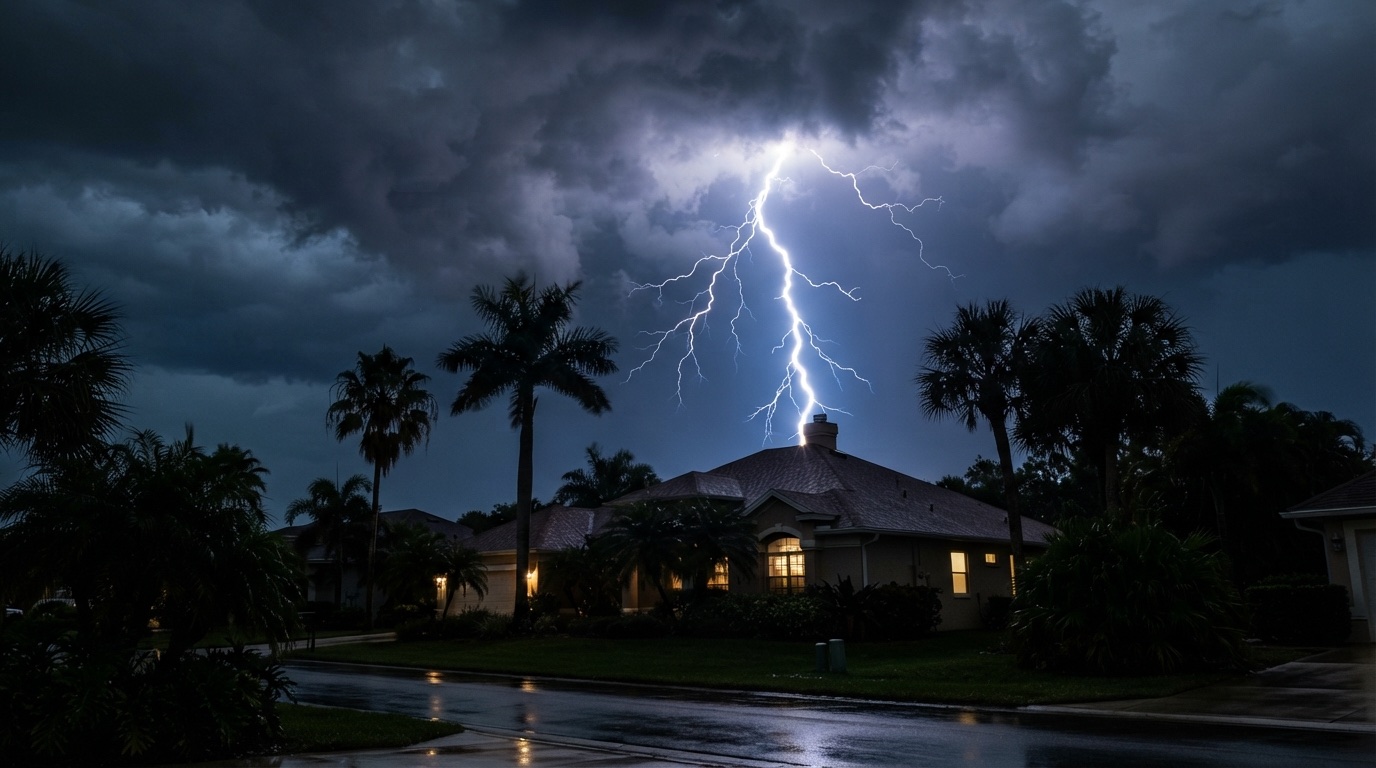
Lightning damage is broadly covered, and routinely disputed, because a strike does its worst work where you cannot see it. A direct strike can burn structure and start a fire, but the more common loss is the power surge that follows, frying electronics, HVAC control boards, well pumps, and electrical systems throughout the building.
The claim turns on proving the strike and tracing its damage. Carriers often pay the obvious and deny the rest, or attribute surge damage to age. Documenting the event and the systems it took out is what makes the claim whole.
What decides a lightning claim in Florida.
Direct strike versus power surge
A direct strike and the resulting fire are one loss; the electrical surge that damages equipment throughout the building is another, and it is where most of the value, and most of the dispute, lives. Both should be documented.
Hidden electronic and system damage
Surges damage circuit boards, appliances, HVAC and pool equipment, well pumps, and low-voltage systems that fail immediately or shortly after. A full inventory of affected equipment, tested and documented, is essential.
Proving the event
Carriers may question whether lightning occurred. Strike-verification data, along with the physical evidence and the pattern of equipment failures, establishes the event and connects it to the damage.
The Florida rules that decide a lightning claim
Florida leads the country in lightning strikes, and the damage is usually electrical rather than structural, which is exactly the kind of loss a carrier under-scopes. These sections were read from the Florida Legislature the day this page was last updated.
The date of loss is verifiable, so use it
Section 627.70132(3) fixes the date of loss for weather-related events by National Oceanic and Atmospheric Administration verification. Strike data is recorded and can be matched to the property, which turns the date of loss from an argument into a record.
The damage you cannot see is still damage
A strike commonly takes out elevator controls, fire alarm and access systems, HVAC boards, pumps, and gate operators rather than anything visible from the parking lot. Section 626.9744(1) includes the physical damage incurred in making a covered repair, which matters when reaching a burned-out control board means opening walls and ceilings.
One year to give notice, eighteen months to supplement, for any peril
Section 627.70132(2) bars a claim or reopened claim unless notice reached the insurer within one year of the date of loss, and bars a supplemental claim after 18 months. It reaches loss or damage caused by any peril, not only weather.
A partial payment has to say it is partial
Under 627.70131(6) a preliminary or partial estimate must carry a bold, uppercase statement that it represents the carrier’s current evaluation and may be revised, and a payment that is not the full and final payment must carry a matching statement that additional payments may follow. If a check arrived with neither, the carrier has treated a first offer as the end of the claim, and that is worth challenging.
Statute text read from the Florida Legislature on 2026-08-24. General information only, not legal advice or a coverage determination. Coverage depends on your specific policy, the facts of your loss, and current Florida law.
What the carrier will try on a lightning claim.
- —Paying visible damage and denying the surge damage to electronics and systems.
- —Attributing failed equipment to age rather than the strike.
- —Questioning whether a lightning event occurred at all.
- —Under-valuing the inventory of damaged electronics and equipment.
We Build Your Claim The Way Ford Built The Assembly Line.
Henry Ford didn’t try to be the expert at everything. He surrounded himself with specialists, each mastering one part of the work, and assembled the result into something no individual could build alone. We document claims the same way. For a serious loss, one adjuster’s opinion is not enough, so we bring in the right specialists, pull a full report from each, and assemble them into a claim the carrier cannot dismiss.
Building Consultants
Read the structure and the code the way an insurer’s engineer does, so nothing covered gets left out of scope.
General Contractors
Real-world repair pricing and sequencing that holds up when the carrier questions the cost to rebuild.
Structural Engineers
Independent reports on causation and structural damage that carry weight the carrier can’t wave off.
Professional Estimators
Line-item Xactimate estimates built to the same software and standards the carrier’s own adjuster uses.
Contents Specialists
Full inventory and valuation of damaged personal property and business contents, item by item.
Water & Mold Testing
Moisture mapping, thermal imaging, and lab testing that prove the source, the spread, and the cause of loss.
We don’t send an adjuster. We send a team.
These specialists are independent third-party professionals brought in for documentation and evidence purposes. CCG does not perform repair work and holds no financial interest in any repair or remediation contract.
Lightning claims: what Florida property owners ask.
Does insurance cover lightning damage?
Yes, lightning is a commonly covered peril, including both a direct strike and the resulting fire, and typically the power surge that damages electrical systems and equipment. The frequent dispute is over how much of the surge damage the carrier will acknowledge.
The strike fried my electronics and AC. Is that covered?
Generally yes, surge damage to electronics, HVAC, appliances, and systems from a lightning event is typically covered. Carriers often pay the obvious damage and resist the equipment damage, so a documented inventory of what failed matters.
How do you prove it was lightning?
Strike-verification data for your location, combined with physical evidence and the pattern of simultaneous equipment failures, establishes the event and ties it to the damage. That is often what moves a skeptical carrier.
The carrier says my equipment just failed from age. Can that be challenged?
Yes. Age is a causation argument, and a cluster of simultaneous failures aligned with a verified strike tells a different story. We document the event and the affected equipment and pursue the covered loss.
General information only, not legal advice or a coverage determination. Coverage depends on your specific policy, the facts of your loss, and current Florida law.
Denied, underpaid, or already closed? Florida law may still give you time to reopen a lightning claim.
Have a lightning loss? Start with a free review.
James reviews every submission personally and responds within 24 hours. No obligation, and no fee unless we recover for you.
← All claim typesReport Your Claim
We respond within 24 hours.